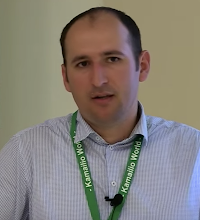
Most innovative solution so far developed by third party to work together with OpenSER was presented for the first time to the public by Voztelecom: WeSIP. CIO Ginez Gomes gave a comprehensive overview of SIP application technologies and why SIP servlet and J2EE allow providers to develop easily new services to attract and secure customers.
It is rather new technology with no many investigating in this direction until now, but since VoIP did lot of first line replacement, something else should ensure further the success of VoIP services. As it happened with HTTP, at the beginning was pure HTML display, mainly oriented to static information sharing. Today even simple sites have dynamic content, with web applications behind, running Java/JSP/Servlet, CGI/Perl/PHP/ASP, Flash, Ajax and others. This came after several years of www, so same comes now to SIP/VoIP.
I am basically pure C programmer, but I salute such initiative and we will try to help as much as possible to get it integrated properly in OpenSER. Making the connector part of OpenSER as module is the first step in creating a proper environment for such extensions.
Main outcome of such solutions is the merge of SIP routing flexibility in OpenSER with enormous programming facilities of Java. Enterprise API as EJB, JDBC, JNDI, SOAP can be used to build quickly on brilliant ideas.
It was required deep knowledge of protocols and low level network communication skills to work on this area, by opening the horizon to application level programmers, the VoIP will burst its business space. Time will prove which technology for VoIP applications is the best, but is no doubt that applications will lead VoIP's future.
Download slides of SIP Application Servers And WeSIP
Showing posts with label voip summit. Show all posts
Showing posts with label voip summit. Show all posts
Sunday, November 19, 2006


OpenSER Summit 2006 - November 8
Day before we met many OpenSER folks at VoN party, chatting around some beers for long time, interesting visions and opinions about VoIP: SIP, P2PSIP, other VoIP systems: Skype, Yahoo... After midnight we left for hotel, we had to be at least one hour before the summit started, to prepare the room . The hall was bigger enough this time, with over 90 places for attendees.
First hour was dedicated to accommodation, coffees and tees, introduction to agenda and OpenSER History. During it, people assembled in the room, so when the first industry perspective started the audience was good. In the last minute we get Olle E Johansson to speak about OpenSER and Asterisk in the open discussion panel.
For statistics, we had 12 speeches and over 20 special guests, including the speakers. Time was rather short for what everything wanted to present, the schedule included a long break for lunch and Expo visit. We had to prolong both morning and afternoon sessions to cover everything planned. Considering that many from the audience stayed to the end (others had to leave some time before to catch the flights), my personal opinion is that what was addressed there gathered good interest.
From the OpenSER management board, the only missing was Juha Heinanen who couldn’t change his plans to be able to attend.
Download slides of
OpenSER Summit 2006: Agenda and OpenSER History
Tuesday, November 14, 2006
OpenSER Summit 2006 - BoF Session
Birds of a Feather: OpenSER for Secure and Performant VoIP Environments - was the short session opening the summit on the 7th November. The location was the Expo theater, a hall rather small, targeted for exhibitor's briefings of new services or products.
Since most of our attendees registered from the first day, the seats were not enough, some had to sit on the floor or stand up. This was quite inconvenient for all and we should look for a better organizing in the future.
The scope of BoF was to give a quick shoot about OpenSER, like a preview of the next day, but not only. We tried to bring in discussion concepts, exemplifying with some implementations when was the case.
The moderator was Xavier Casajoana, CEO Voztelecom, who had to talk instead of Jesus Rodrigues as well, who's flight was delayed. Therefore, he presented interesting views over hosted services and how to make such business successful. He underlined that replacement of first voice line is outdated in VoIP and the key is the innovation, to bring adjacent services and applications. Other major benefit of hosted services is the immediate roll out of the service, there is no time needed to set up the VoIP platform, you just have to label an existing one.
Actually the first presentation was about SIP services in distributed environments, by Bogdan-Andrei Iancu, CEO Voice System, co-founder OpenSER project. Laying out distribution types in VoIP, his talk focused on reasons and implications of such deployments. What can be distributed and for what reason, when someone should start concerning about distributing his VoIP system and where to look for, all those where spotted in the speech.
The slot about 3/4G and convergence was held by James Tagg, Managing Director Truphone. Already experienced in this area, the Truphone service bringing VoIP to mobile phones is launched in beta stage since VoN Boston, he addressed the benefits for users and the merits of open source IP telephony applications to apply quickly new ideas.
Of course ENUM couldn't miss the debate. The fight for ENUM control delayed its adoption. Klaus Darilion, Enum.at, spoke about new concept of infrastructure ENUM that will enable carriers to apply the requirements they must have is this kind of business.
Ending speech was about peering with heterogeneous networks. Daniel-Constantin Mierla, co-founder OpenSER projects, revealed numbers about subscriber base of other IM/VoIP networks, motivating why they cannot be ignored or isolated. The solution is to interoperate with them, adding value to your service. The main focus in short term is XMPP interoperability (Jabber,GoogleTalk).
The questions slot started with OpenSER vs. Asterisk. Bogdan cleared it by explaining they are complementary, not overlapping. I presented shortly the steps done so far for an easy integration of OpenSER and Asterisk, tutorials being available on voip-info.org and dokuwiki from openser.org.
Someone insisted in getting a good solution of serving 100 000 000 users with a OpenSER+SS7 system. SS7 is not a primary target for OpenSER as it was designed to work at signaling level, to be hardware independent and not deal with media stream. All panelists gave alternative solutions for such large deployment and technology requirement.
Other question was about Enum's heavy process of adoption. Overall conclusion of Klaus was that improper legislation and the carriers not seeing direct benefits with current standardizations made the adoption rather difficult.
Download slides of BoF: OpenSER - for secure and performant VoIP environments
Since most of our attendees registered from the first day, the seats were not enough, some had to sit on the floor or stand up. This was quite inconvenient for all and we should look for a better organizing in the future.
The scope of BoF was to give a quick shoot about OpenSER, like a preview of the next day, but not only. We tried to bring in discussion concepts, exemplifying with some implementations when was the case.
The moderator was Xavier Casajoana, CEO Voztelecom, who had to talk instead of Jesus Rodrigues as well, who's flight was delayed. Therefore, he presented interesting views over hosted services and how to make such business successful. He underlined that replacement of first voice line is outdated in VoIP and the key is the innovation, to bring adjacent services and applications. Other major benefit of hosted services is the immediate roll out of the service, there is no time needed to set up the VoIP platform, you just have to label an existing one.
Actually the first presentation was about SIP services in distributed environments, by Bogdan-Andrei Iancu, CEO Voice System, co-founder OpenSER project. Laying out distribution types in VoIP, his talk focused on reasons and implications of such deployments. What can be distributed and for what reason, when someone should start concerning about distributing his VoIP system and where to look for, all those where spotted in the speech.
The slot about 3/4G and convergence was held by James Tagg, Managing Director Truphone. Already experienced in this area, the Truphone service bringing VoIP to mobile phones is launched in beta stage since VoN Boston, he addressed the benefits for users and the merits of open source IP telephony applications to apply quickly new ideas.
Of course ENUM couldn't miss the debate. The fight for ENUM control delayed its adoption. Klaus Darilion, Enum.at, spoke about new concept of infrastructure ENUM that will enable carriers to apply the requirements they must have is this kind of business.
Ending speech was about peering with heterogeneous networks. Daniel-Constantin Mierla, co-founder OpenSER projects, revealed numbers about subscriber base of other IM/VoIP networks, motivating why they cannot be ignored or isolated. The solution is to interoperate with them, adding value to your service. The main focus in short term is XMPP interoperability (Jabber,GoogleTalk).
The questions slot started with OpenSER vs. Asterisk. Bogdan cleared it by explaining they are complementary, not overlapping. I presented shortly the steps done so far for an easy integration of OpenSER and Asterisk, tutorials being available on voip-info.org and dokuwiki from openser.org.
Someone insisted in getting a good solution of serving 100 000 000 users with a OpenSER+SS7 system. SS7 is not a primary target for OpenSER as it was designed to work at signaling level, to be hardware independent and not deal with media stream. All panelists gave alternative solutions for such large deployment and technology requirement.
Other question was about Enum's heavy process of adoption. Overall conclusion of Klaus was that improper legislation and the carriers not seeing direct benefits with current standardizations made the adoption rather difficult.
Download slides of BoF: OpenSER - for secure and performant VoIP environments
Subscribe to:
Posts (Atom)